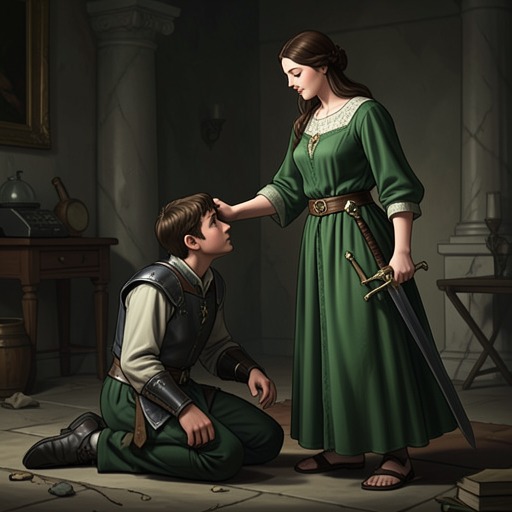
Rilian and the Green Witch
The Silver ChairRilian and the Green Witch are captor and captive, but their relationship also joins a concealed murder to a struggle over identity and rightful rule. After ten years under her enchantment, Rilian recovers his judgment, repudiates the violent kingship she had planned for him, and identifies her as the creature responsible for his mother’s death. Their conflict ends when the Witch becomes a serpent and Rilian, aided by his friends, kills her.
Captivity and concealed identity
The Green Witch has bound Rilian through sorcery and kept him in her power for ten years. The Silver Chair is described as his only safety: when he is released from it, she arrives and asks whether his familiar nightly fit has begun or ended, why he is unbound, and who the strangers are. His shivering response makes clear that the spell’s hold does not disappear as soon as the chair is destroyed. Even after the enchantment has ended, it takes effort for him to speak and recover his bearings.
The Witch’s power has obscured Rilian’s understanding of himself and his history. He now says that he is in his right mind, identifies himself as the son of Caspian X and the sole child of the Narnian king, and states that he must leave her court for his own country. The disclosure changes the relation between them: the person she has controlled is not merely a dependent in her court, but the missing heir to Narnia, able to name both his identity and his duty.
Rilian rejects her political design
Rilian directly repudiates the Witch’s plan to put him at the head of an army of Earthmen and send him into the Overworld. He understands that the proposed campaign would force him to seize a nation that had done him no wrong, murder its rightful rulers, and occupy its throne as a foreign tyrant. Now that he knows himself, he declares the plan villainy and renounces it. His refusal is not simply an escape from personal captivity: it denies the Witch the means to turn his royal identity into an instrument of conquest.
He also asks the Witch for safe conduct and a guide through her dark realm, presenting his departure as both purpose and duty. The request exposes the sharp imbalance between his restored self-command and his continued dependence on the route out of her domain. She gives no answer. Instead, she moves toward a small wall cupboard, takes out green powder, and casts it onto the fire; she then begins playing a mandolin-like instrument. The growing fragrance and steady music make clear that she is trying to cloud the company’s thinking again rather than accept Rilian’s decision.
The Witch’s transformation and death
While the Witch’s music and influence have begun to take effect, Puddleglum resists her enchantment. Rilian then warns the others to look at her. The instrument falls from her hands, and her human shape changes rapidly into a large green serpent. She throws coils around Rilian’s legs and chest and tries to trap his sword arm. Rilian catches her neck with one hand and draws his sword with the other, holding her off long enough for his companions to come to his aid.
Rilian’s sword and Puddleglum’s blows strike the serpent’s neck; Eustace Scrubb also attacks, though his blow does not pierce its scales. The Witch’s hold loosens, and the three repeatedly strike until they sever her head. The scene resolves their conflict through combined action: Rilian confronts his former captor directly, but he does not defeat her alone. Afterward he thanks his companions and identifies the serpent as the same creature he pursued unsuccessfully near a fountain in the forest of Narnia years earlier.
The murder that binds them
Rilian recognizes the Witch as his mother’s slayer and says that he has been the slave of that killer throughout his captivity. The revelation joins two periods of his life that the enchantment had kept apart: the earlier pursuit of the serpent and the years spent under the Witch’s control. Her human presentation had hidden the connection; her final transformation makes it legible to him. He declares that his royal mother is avenged, giving the serpent’s death the additional meaning of justice for a murder that preceded his enslavement.
Rilian also distinguishes the creature’s serpent form from the woman the Witch had appeared to be. He says that killing her in that human appearance would not have accorded with his heart or honour, and expresses relief that she revealed herself as a serpent at the last. The passage thus makes his revenge inseparable from a limit on how he is willing to enact it: he kills the creature he identifies as his mother’s murderer, while emphasizing that he would not have wished to kill a woman.
A relationship reversed
At the beginning of their confrontation, the Witch questions Rilian as though he remains her subject and asks why he is free of the chair. By the end, he has named her deception, rejected her intended conquest, and joined in her defeat. The power she maintained through enchantment gives way first to his recovered memory and then to coordinated resistance from Rilian, Puddleglum, and Eustace. Her death closes the private struggle between captor and captive, while Rilian’s recovered identity and departure from her court reestablish his claim to return to Narnia as its king’s son.